
Verified Ankeny Directory Runs
Ankeny does not have one verified complete city-only run on a public shelf list. The strongest coverage comes from Des Moines and Polk County volumes, plus later suburban books that expressly include Ankeny. Missing years matter. A catalog entry proves a title exists, but it does not prove that every local library has the volume today.
| Collection | Years | Where held | Access |
|---|---|---|---|
| Mills & Co. | 1866, 1869 | Des Moines Public Library | Microfilm and guide |
| J.P. Bushnell | Selected 1871-1889 | DMPL | Microfilm |
| R.L. Polk & Co. | Selected 1892-1922 | DMPL | Print, microfilm and digital |
| DMPL print directories | 1910-present | Central Library | In person |
| DMPL telephone books | 1957-present | Central Library | In person |
| Koch Brothers suburban volumes | 1996, 1998, 1999, 2000 | Iowa Genealogical Society catalog | Verify current holder |
The 1910s DMPL list omits 1918, and earlier decades are not annual. Never treat a missing volume as proof that a family left Polk County. Search the nearest year on each side, then use census, deed or newspaper evidence.
DMPL Holds the Ankeny Core
The Des Moines Public Library directory guide is the best verified entry to the Polk shelf. It describes digitized city directories from 1866 through 1922, microfilm from 1866 through 1935, print volumes from 1910 to the present, and telephone books from 1957 onward.
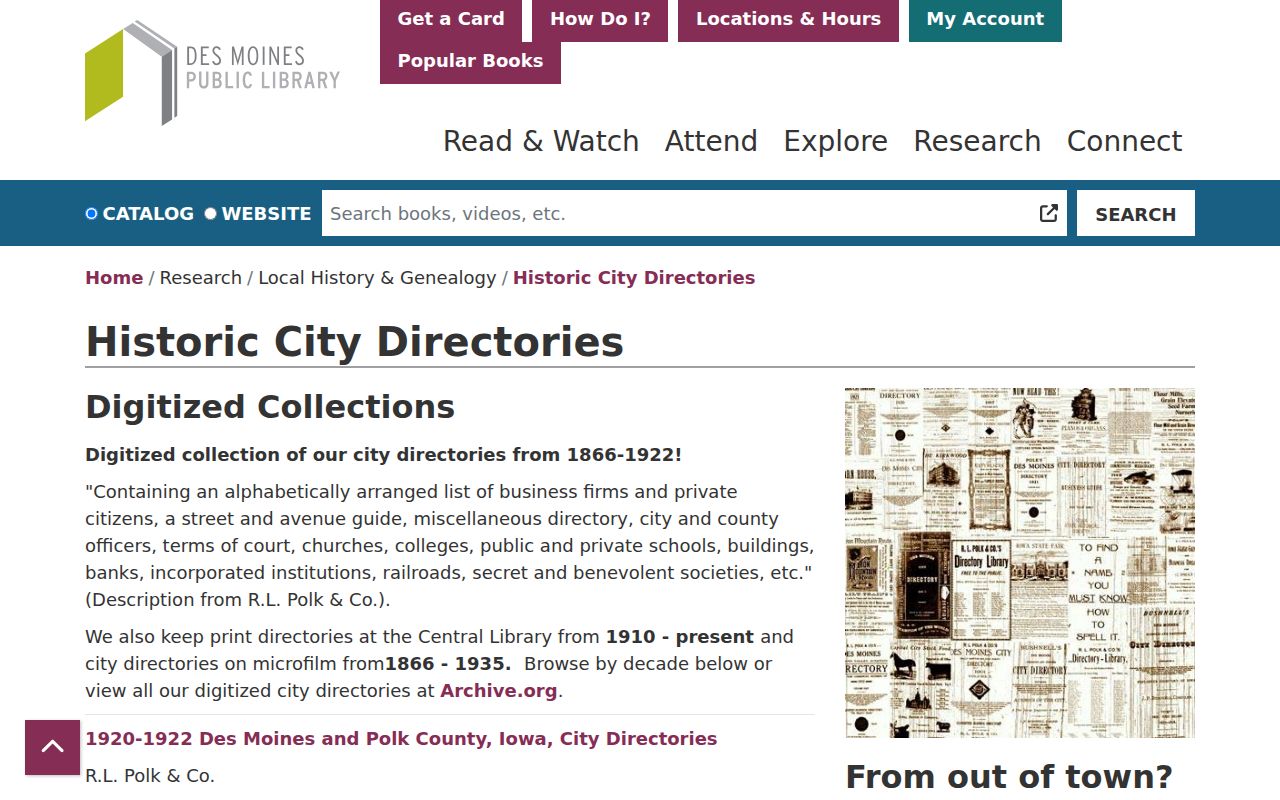
The collection holds more than names. Volumes may include street guides, firms, churches, schools, public officers and societies. Those sections can decode a place or civic clue. Ask staff about format and missing years before visiting.
Open a Polk Directory Online
A digitized 1920 Des Moines and Polk County directory offers text search, PDF access and page images. Search text is fast, but the scan controls. OCR can split a surname, confuse an initial or misread a house number.
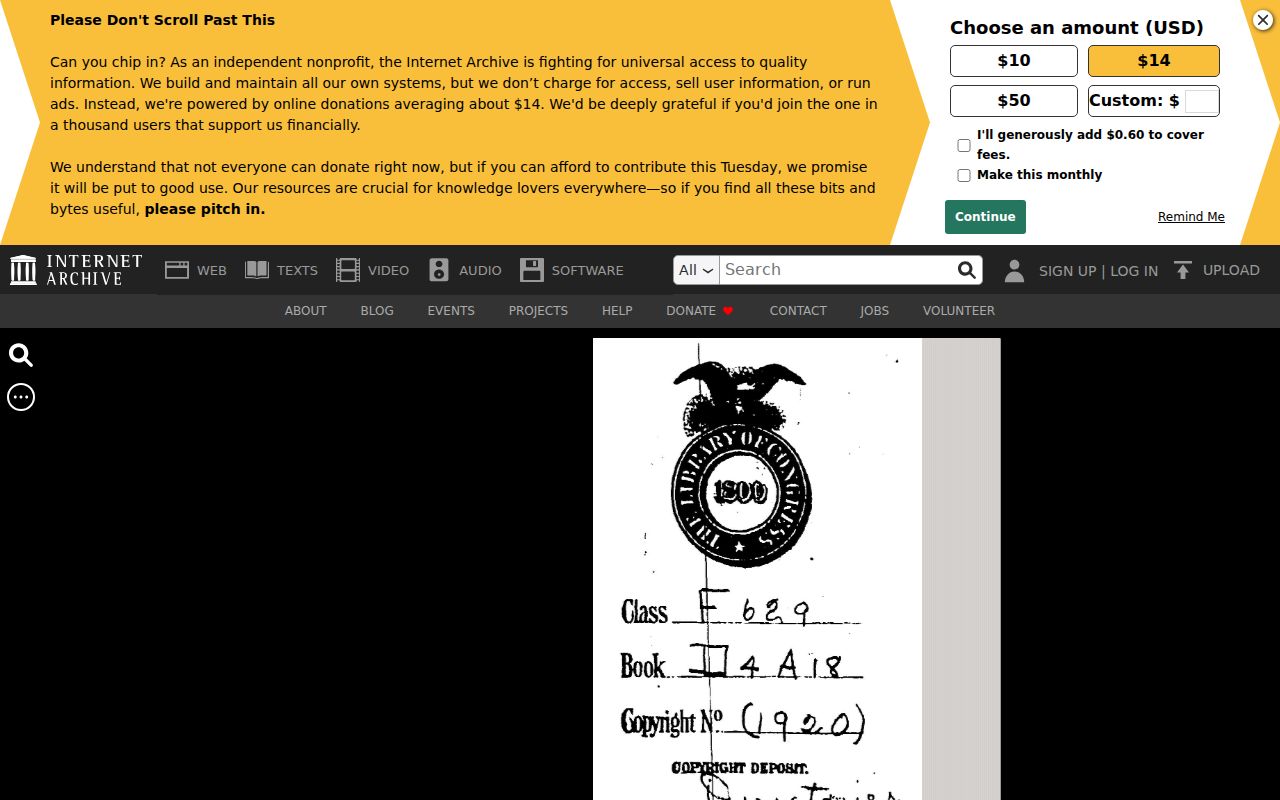
Search a surname and its variants, open the matching page, record the printed wording, and inspect the street guide. Cite the page rather than relying on a search snippet.
Read an Ankeny Directory Entry
The inspected 1920 volume lists John L. Aukerman with an abbreviated trade and “res 2052 Ankeny.” L. Sylvester Aukerman appears as a custodian who “bds” at the same address. These are brief printed clues, not full biographies.
| Name | Surname, given name or initials |
|---|---|
| Work clue | Occupation or business affiliation |
| Residence mark | “res” identifies residence wording in this run |
| Boarding mark | “bds” describes boarding |
| Address | Street and number checked against the street guide |
| Not shown | No birth date or age in the inspected lines |
Find the volume's own key before expanding any mark. Publishers changed forms, and symbols can vary by year.
- Criss-cross directory
- A volume arranged by street and house number for address-first research.
- Householder index
- An arrangement centered on the person named for a household entry.
- Abbreviation key
- The publisher's list that decodes short forms used in that volume.
Ankeny Avenue Creates False Hits
The word “Ankeny” in a Polk County directory is not automatic proof of residence in the City of Ankeny. The 1920 street guide defines Ankeny Avenue in Des Moines, from East 20th to 22nd and north of Lyon. The Aukerman entries at 2052 refer to that street.
Check the city or county heading, street-guide definition and cross streets. “Ankeny” might also be a business name, post-office reference or institution. A page image with geography is stronger than one OCR hit.
Ankeny Memory Fills Directory Gaps
The Ankeny Area Historical Society helps when city directory years are absent. Holdings include local newspapers, photographs from 1900 forward, school yearbooks, family histories, oral histories, maps and history books.
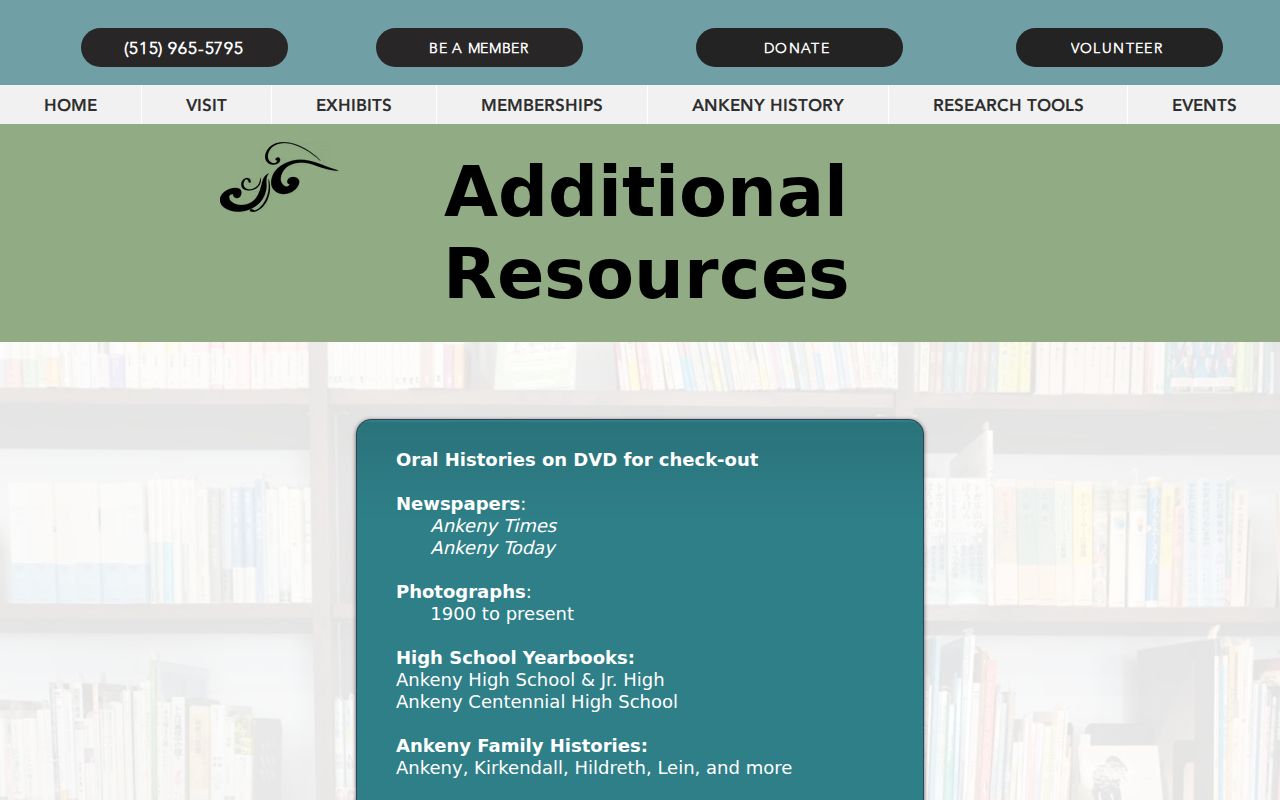
The Society image represents a local-memory layer, not a complete name index. Use a yearbook for a class clue, a paper for a dated event and oral history for context. The Society at 301 SW Third Street holds seasonal open houses and offers appointments.
Its Ankeny Through the Decades project draws on Ankeny Times, Ankeny Today and Ankeny Press-Citizen material. The selected features are extensive but not a full chronology.
Kirkendall Supports Ankeny Research
Kirkendall Public Library is the local first stop for catalog help, newspaper questions and licensed genealogy tools. Ancestry Library Edition is available in the library, while HeritageQuest is listed for card access. No complete Ankeny-only directory run or public obituary index was verified on its pages.
Ask staff about uncataloged items rather than assuming none exist. Kirkendall is at 1250 SW District Drive, phone 515-965-6460. Hours are Monday through Thursday 9 a.m. to 8 p.m., Friday and Saturday 9 a.m. to 5 p.m., and Sunday 1 to 5 p.m.
Ankeny Directory Access Timeline
The directory trail changes publisher, medium and geographic scope. That is why one catalog search cannot span all Ankeny history.
| Period | Verified change |
|---|---|
| 1866 and 1869 | Mills & Co. begins the verified DMPL run. |
| 1870s-1880s | Selected J.P. Bushnell years appear. |
| 1890s-1922 | Selected R.L. Polk & Co. volumes carry the classic run. |
| 1957-present | DMPL lists telephone books separately. |
| 1996-2000 | Koch Brothers titles expressly include Ankeny in selected suburban volumes. |
Ankeny's growth also changes the scale. Population rose from 45,582 in the 2010 Census to 67,887 in 2020. Later plats, annexation records and current property sources matter when linking an old entry to today's city.
Trace Ankeny Families by Year
City directories work best as dated checkpoints. One absence can mean a missing volume, altered spelling, an unlisted person, a move or a death. Test each possibility elsewhere.
- Find the surname alphabetically, including initials and spelling variants. Save the page and year.
- Record the address, work clue, residence or boarding mark and related names exactly.
- Check the street guide and city heading to avoid the Ankeny Avenue trap.
- Search the nearest available volumes before and after the hit. A publication gap is not a move.
- Pair the directory with a federal census year. Public schedules through 1950 may add household facts.
- Use deeds, probate, newspapers, yearbooks or cemetery sources to test the conclusion.
The State Historical Society's Polk holdings extend the trail through deeds, plats, probate, naturalization, vital and tax series. Some special collections require an appointment. For present-day address research, shift to the Ankeny street directory.
The federal census adds a wider household frame between directory checkpoints. Public population schedules through 1950 may provide names, ages, birthplace, marital facts and a street address when the schedule survives. The 1890 census was largely destroyed, so an Ankeny city directory near that decade can be especially useful. Still, publication and enumeration dates differ. Record both dates and do not merge two households merely because a surname and street match.
Probate and obituary research can explain why a name vanishes. State Historical Society Polk collections include wills from 1850 through 1893, probate bonds from 1866 through 1902 and case files from 1846 through 1914. Newspapers and cemetery material can supply family ties or a death date. Naturalization files offer another route for some residents, with Polk microfilm including petitions and records from 1907 through 1927. Each source should confirm a precise fact, not fill a gap through guesswork.